Partnership drives our business


Planters
Those who grow our food (farmers)
We exist to serve our 6 'P's
Producers
Those who make our food (food manufacturers)
People
We who eat the food (consumers)
Planet
The world we share
Partners
The people who work for
and with us
Patrons
The investors who allow us to deliver
Partnering with leading institutions in the field












The National Alternative Protein Innovation Centre (NAPIC) is the UK’s flagship capability for accelerating the development, scale-up and adoption of alternative proteins.
Bringing together world-leading academic expertise, industrial partners and translational infrastructure, NAPIC is designed to bridge the gap between discovery science and commercial deployment. Its Produce pillar, led by internationally recognised researchers, focuses on unlocking high-quality, functional and nutritious proteins from plants and other natural feedstocks, with sustainability, circularity and real-world impact at its core. NAPIC’s strength lies not only in scientific excellence, but in its ability to co-create solutions with industry that are aligned to market needs and food system transformation
Within the "Brotein" project, NAPIC – through its leadership and research capability at The James Hutton Institute – is playing a pivotal role in advancing broccoli biomass side streams as a viable, nutritious and sustainable protein source. The NAPIC team is supporting the optimisation of protein extraction processes from underutilised broccoli biomass, applying advanced plant and food chemistry, analytical science and life-cycle assessment to improve yield, functionality and environmental performance. This work is generating robust scientific evidence likely to lead to published papers, sustainability metrics and comparative data against established protein sources such as soy and pea, while simultaneously feeding into UPP's intellectual property development and roadmap for commercialisation.
What makes this collaboration unique is the way NAPIC’s deep scientific and sustainability expertise is tightly integrated with UPP’s decentralised harvesting and processing platform. Rather than treating alternative protein as a purely laboratory or factory-based innovation, Brotein combines NAPIC’s capability in protein quality, functionality and lifecycle assessment with UPP’s patented whole-crop harvesting and processing model. This creates a rare end-to-end system that captures value directly from existing food production, retains it within rural communities, and delivers credible, scalable alternative proteins with proven environmental benefits. The result is a distinctive, highly differentiated approach that exemplifies NAPIC’s mission: translating world-class science into commercially viable, sustainable protein solutions at scale.

The James Hutton Institute is internationally recognised for its excellence in crop science, food systems and sustainable agriculture, bringing decades of applied research experience to some of the most pressing challenges facing farming and food production.
Its strengths span crop quality, plant biochemistry, protein functionality, nutrition and environmental sustainability, underpinned by world-class laboratory infrastructure and translational expertise. The Institute has led and supported numerous UK and EU programmes focused on improving the value, resilience and sustainability of agricultural systems, with a proven track record of turning fundamental science into deployable, real-world solutions.
The James Hutton Institute is internationally recognised for its excellence in crop science, food systems and sustainable agriculture, bringing decades of applied research experience to some of the most pressing challenges facing farming and food production. Its strengths span crop quality, plant biochemistry, protein functionality, nutrition and environmental sustainability, underpinned by world-class laboratory infrastructure and translational expertise. The Institute has led and supported numerous UK and EU programmes focused on improving the value, resilience and sustainability of agricultural systems, with a proven track record of turning fundamental science into deployable, real-world solutions.
The Manufacturing Technology Centre (MTC) is a scale-up and industrialisation partner that helped UPP turn pioneering field robotics into manufacturable, certifiable, deployable equipment.
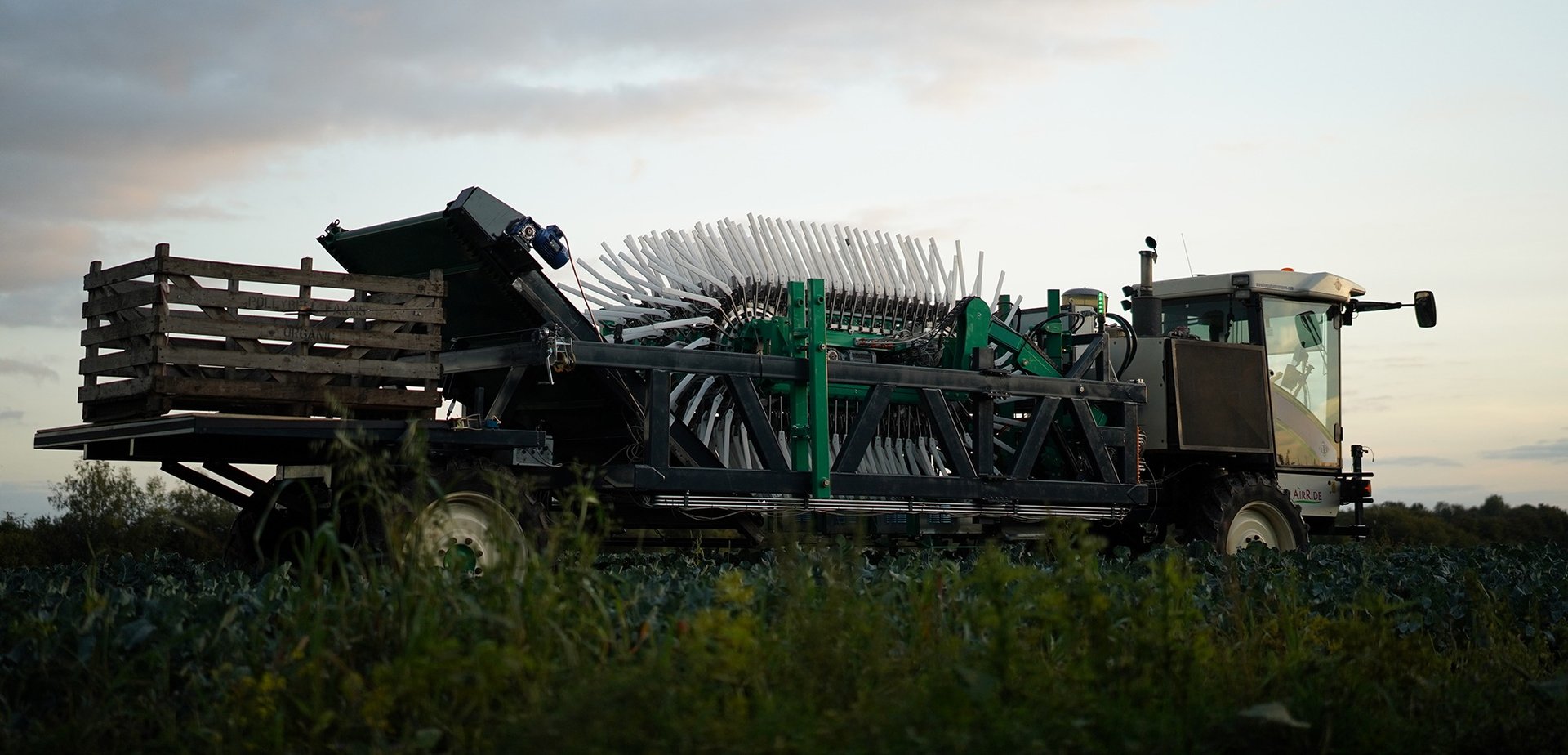
In the AgriScale Advanced Manufacturing Pilot Programme, MTC applied its robotics and scale-up expertise to accelerate commercialisation - specifically supporting UPP with design for manufacture and assembly (DFMA) for its automated broccoli harvesting platform, so the technology can transition to a repeatable build and sustained real-world deployment, strengthening UK food supply chains through smarter, scalable solutions.
This project brought together MTC and UPP under Innovate UK’s AgriScale Advanced Manufacturing Pilot Programme, to fast-track this automation breakthrough for UK horticulture. The focus is on UPPs automated broccoli harvester which is designed to capture more of the plant (including nutritious stalk that is typically left in-field) during automated harvest — reducing labour intensity and unlocking additional value by allowing the recovered biomass to be converted into hypoallergenic plant-based protein and fibre ingredients. More details can be found here.
UPP has entered a strategic harvest and supply partnership with East of Scotland Growers (ESG) to secure large-scale, grower-aligned feedstock for its ingredient platform while delivering measurable economic and environmental outcomes at farm level. The agreement enables deployment of UPP’s automated selective harvesting technology across ESG farms, unlocking up to 100,000 tonnes of side-stream biomass annually for food-grade ingredient production. Material that would traditionally be left in-field or downgraded to low-value uses is instead upgraded into protein and fibre ingredients, creating a new, scalable value stream rooted in UK agriculture.
The partnership is structured to align incentives across growers, processors, and downstream food customers, while reducing execution and supply-chain risk. Automation lowers dependence on seasonal labour, reduces harvest cost volatility, and improves yield recovery for growers, while providing UPP with a consistent, traceable, high-volume feedstock supply. ESG participates directly in the value created downstream through a margin-share model, without taking on additional capital or operational risk. This shared-value structure strengthens long-term supply security and underpins UPP’s ability to scale ingredient production with confidence.
For investors and strategic acquirers, the ESG partnership demonstrates how UPP converts sustainability into infrastructure and economics rather than narrative. It locks in feedstock at scale, improves unit economics by upgrading nil-value biomass, and delivers auditable Scope 3 emissions reduction through operational change at source. For Tier-1 food producers and retailers, it reinforces UPP’s position as a procurement-grade partner offering reliable UK supply, full traceability from field to factory, and credible ESG performance embedded in the supply chain. Together, the partnership exemplifies UPP’s system-level approach: building resilient, capital-efficient food infrastructure that compounds value across agriculture, manufacturing, and sustainability objectives.

Partner with us
We are a system-level ingredient company that converts underutilised crop side-streams into specification-grade ingredients at scale.
By optimising the entire chain from harvest through processing, we unlock feedstocks others cannot economically use and convert natural variability into margin through multi-SKU outputs and defined blending pathways.
Rather than betting on capital-intensive monolithic production facilities, we will scale by replicating proven, standardised modules, reducing risk, shortening commissioning time, and improving capital efficiency.
With safety certification imminent and active commercial shipments, we are 'built to win' on system-level cost, regulatory simplicity, reliability, flexibility and optionality across ingredient applications.
Get in touch
© 2026. All rights reserved.
Upcycled Plant Power ('UPP') Limited
trading as "UPP" and "Freya"
Company number: 14171122
VAT Number: 428 2222 17
Registered address:
Agri-Tech Centre
Poultry Drive, Edgmond,
Newport, Shropshire
United Kingdom TF10 8JZ
Connect with us
Broccoli is a natural source of vitamin K and contains folate, potassium and beta-carotene, a provitamin A carotenoid. Our Fiba and Prota products are a source of fibre, making them nutritionally valuable ingredients.